TL;DR — Gemini and Google's AI Overviews are built on Google Search. To be named, make sure Google can index and understand you, answer buyer questions directly on your pages, keep your business details identical everywhere, and earn mentions and reviews on the sites Google trusts.
More buyers now ask Gemini, or read the AI Overview at the top of Google, before they click anything. If you're named there, you're on the shortlist before the search results even start. This guide covers how Google's AI picks its sources and what consultants can do to become one of them. For ChatGPT, see our companion guide on how to get recommended by ChatGPT.
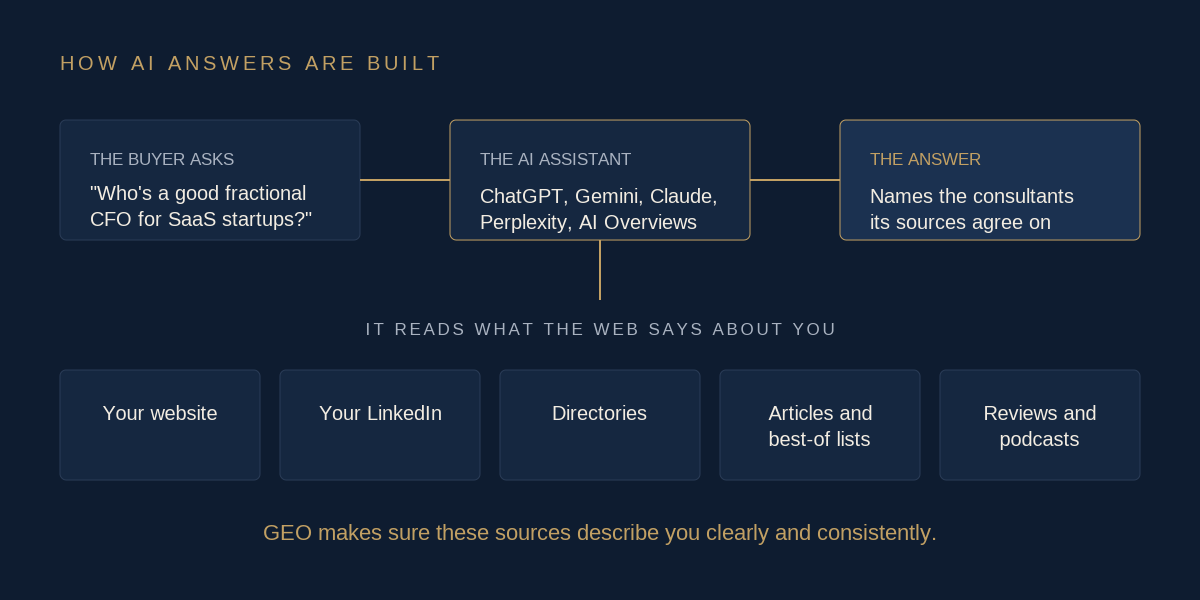
How Gemini and AI Overviews choose sources
Both are grounded in Google Search. When they answer a question like "who's a good fractional CFO for SaaS startups?", they draw on pages Google has indexed and trusts, then summarise and cite a handful. That means classic SEO is the foundation: if Google can't find, crawl and understand your pages, Gemini won't use them.
Step 1: Make sure Google can see you
- Verify your site in Search Console and submit your sitemap.
- Check every key page is indexed. New pages can sit in "discovered, not indexed" for weeks; request indexing for the important ones.
- Allow Google-Extended in robots.txt. It's the setting that controls whether Google can use your content for Gemini. Many sites block it without realising.
Step 2: Answer the question in the first lines
AI Overviews quote pages that answer directly. Open each service page and guide with a one- or two-sentence answer to the question it targets, then expand. Use headings phrased the way buyers ask: "How much does a fractional CFO cost?", "What does a marketing consultant do?".
Step 3: Make your business unmistakable
Google's AI needs to be confident who you are:
- A Google Business Profile with the same name, address, phone and description as your site.
- Structured data on your site: Organization, Person, Service and FAQ markup.
- An author page that shows who writes your content and links to your LinkedIn.
- The same one-line description of your niche on your site, LinkedIn and every directory.
Step 4: Earn mentions on the sites Google trusts
Google's AI leans on sources with authority: industry publications, "best of" lists, directories with reviews, podcasts, and discussion sites such as Reddit. One mention on a respected site in your niche can matter more than another article on your own. Our guide to backlinks for consultants covers how to earn them.
Step 5: Show real experience
Google rewards content written from first-hand experience. Use your own examples, client results (with permission) and specific numbers. Generic advice that could have been written by anyone rarely gets cited.
Step 6: Check, then check again
- Ask Gemini your buyers' questions in a private window, monthly.
- Look at the generative AI report in Search Console for impressions in AI features.
- Note which sites Gemini cites for your topics, and work on being mentioned there.
Our free AI visibility checker writes the buyer questions for you and opens them in ChatGPT, Gemini, Claude, Perplexity and Google.
The bottom line
Gemini recommends consultants Google already understands and trusts. Be indexed, answer clearly, keep your details consistent and earn credible mentions, and you give it every reason to name you.
Related reading
- How to Get Recommended by DeepSeek, Grok, Kimi and Manus
- How to Get Recommended by Perplexity
- How to Get Recommended by Claude
- How to Get Recommended by Microsoft Copilot
- How to Get Recommended by ChatGPT as a Consultant
- What Is GEO? Generative Engine Optimisation for Consultants
- SEO vs GEO: What's the Difference?