TL;DR — SEO gets your pages ranked on Google. GEO gets your name into AI answers. They share the same foundations, clear pages, useful content and credible mentions, but each has its own extra work. Consultants need both, because buyers now research in both places.
Two ways buyers look for help
Some buyers type a search into Google and scan the results. Others ask ChatGPT, Gemini, Perplexity, Claude or Google's AI Overview a question and read the answer. Many do both.
SEO is how you show up in the first. GEO is how you show up in the second.
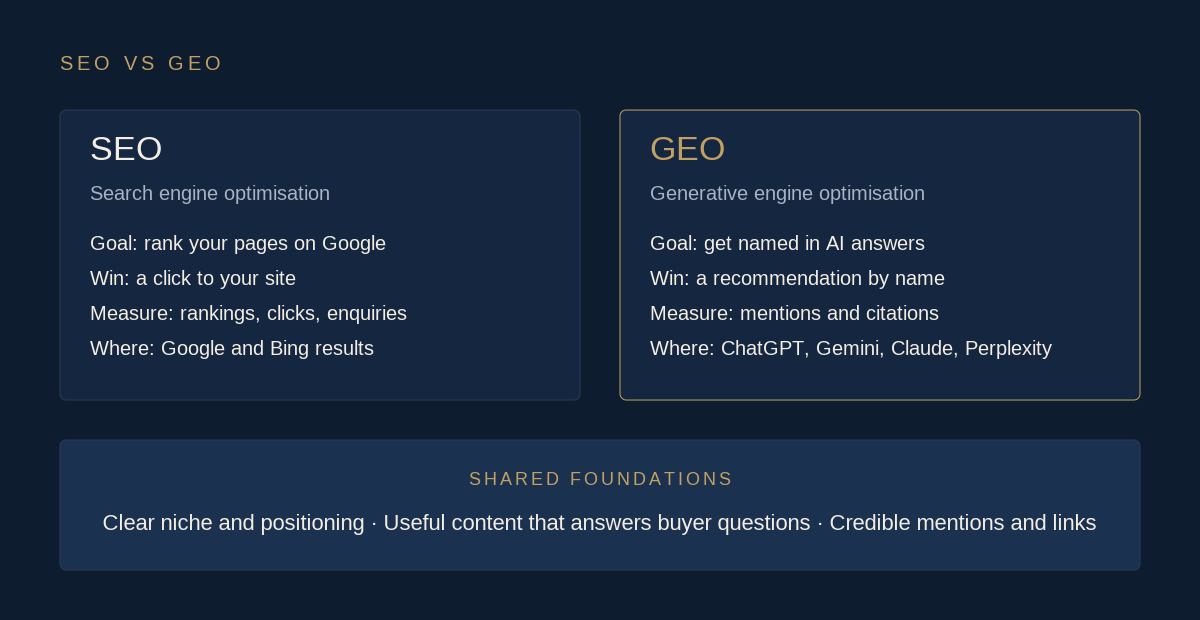
What SEO does
Search engine optimisation aims to rank your pages as results for the searches your buyers make. Success looks like your service page appearing on page one for "fractional CFO for SaaS", and someone clicking through.
Typical SEO work:
- Keyword research to find the searches worth winning
- Technical fixes so pages can be crawled and indexed
- Service, niche and location pages
- Articles targeting specific searches
- Backlinks from relevant sites
What GEO does
Generative engine optimisation aims to get you mentioned inside AI-generated answers. Success looks like ChatGPT naming you when someone asks for a recommendation, or Perplexity citing your article in its answer.
Typical GEO work:
- Making your positioning clear and consistent everywhere
- Structuring content so it directly answers questions
- Getting mentioned in comparison articles, directories and roundups that AI tools cite
- Structured data and plain-language summaries of who you are
- Checking what AI tools say about you and your competitors
Where they overlap
Most of the work counts twice:
- Clear, specific positioning helps you rank for niche searches and helps AI describe you accurately
- Useful content ranks on Google and gets quoted by AI
- Credible mentions and links build search authority and give AI tools sources that corroborate who you are
- A technically sound site can be crawled by search engines and AI tools alike
Where they differ
- The goal: SEO wants a click. GEO wants a mention, which may or may not lead to a click.
- The format: SEO rewards a complete page targeting a search. GEO rewards clear, quotable answers and consistent facts.
- The sources: SEO focuses on your own pages ranking. GEO cares a lot about what other sites say about you.
- Measurement: SEO has mature tools for rankings and traffic. GEO is newer, and is often measured by checking AI answers directly and tracking enquiries that mention AI.
Why consultants need both
Your buyers do not care which tool they use. They want to find someone who can help. Covering both means you show up wherever they look, and because the foundations are shared, doing both is far more efficient than doing either on its own.
The bottom line
Do not treat SEO and GEO as rival strategies. Treat them as one: build the foundations, then add the extra SEO and GEO work on top. That is exactly how Kräfte runs SEO and GEO for consultants.