TL;DR — AI assistants recommend consultants who are easy to understand and widely corroborated. Audit what they say today, make your positioning crystal clear and consistent, publish content that answers buyer questions directly, and get mentioned in the comparison articles, directories and publications AI tools cite.
Why this matters now
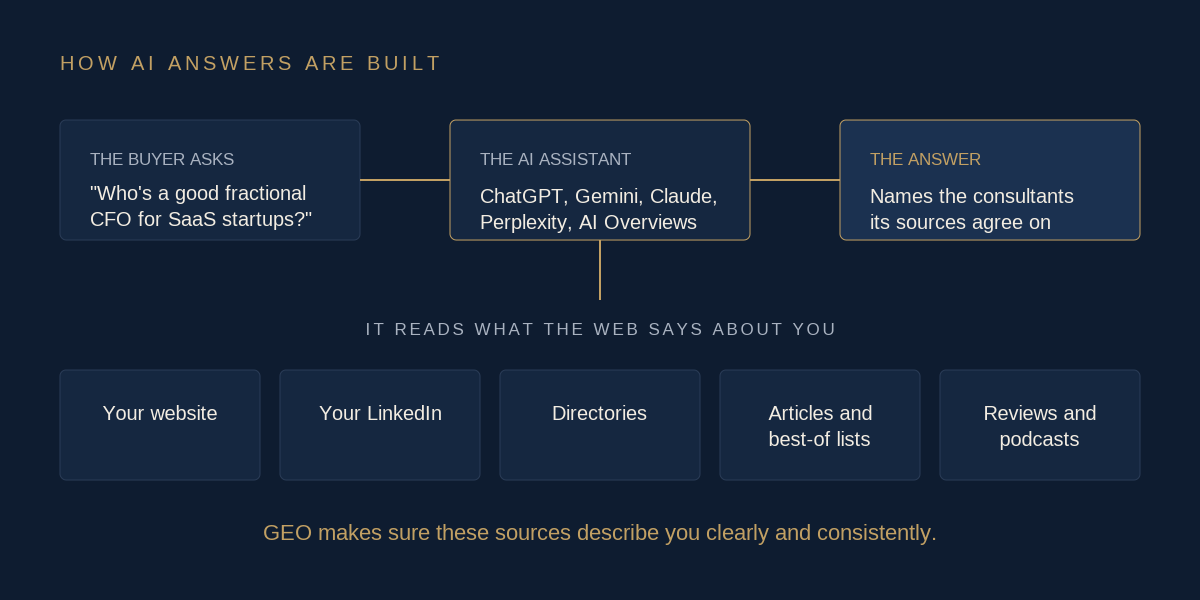
"Recommend a LinkedIn consultant for financial advisers." "Who are the best AI automation consultants for accounting firms?" More buyers are typing questions like these into ChatGPT, Gemini, Perplexity, Claude and Google instead of browsing search results.
The answer is a shortlist. If you are on it, you start the relationship with an implied recommendation. If you are not, the buyer may never know you exist.
Each assistant finds sources a little differently, so we also have guides for Gemini, Perplexity, Claude and Microsoft Copilot.
How ChatGPT finds you when it searches
When ChatGPT searches the web, it draws on search partners, notably Microsoft Bing, as well as OpenAI's own crawler. That has three practical consequences:
- Be in Bing, not just Google. Add your site to Bing Webmaster Tools and submit your sitemap. Many consultants never do, and ChatGPT can't cite what Bing hasn't seen.
- Let OpenAI's crawlers in. Check that your robots.txt doesn't block OAI-SearchBot or GPTBot.
- Tell search engines about new pages quickly. IndexNow pings Bing the moment you publish or update a page.
Step 1: Audit what AI says today
Write down five to ten questions your buyers would ask. Mix recommendation questions with problem questions:
- "Who are the best [your service] for [your niche] in [your region]?"
- "How do I choose a [your service]?"
- "What does a [your service] cost?"
- "[Your name]: what do they do?"
Ask each one in ChatGPT, Gemini, Perplexity, Claude and Google. For each answer, note:
- Who is mentioned
- How they are described
- Which sources are cited or linked
- Whether you appear, and if so, whether the description is accurate
The cited sources are the most valuable part. They tell you exactly which sites the AI trusts on your topic.
Step 2: Make your positioning impossible to misread
AI tools need to match you to a question. Vague positioning makes that hard.
- Say who you help, what you help them do and where, in one plain sentence
- Use that same sentence, or close to it, on your site, LinkedIn, directory profiles and author bios
- Give each service its own page with a clear name and description
- Add structured data to your site describing your business, services and location
If you are a generalist, this is the step where specialising pays off.
Step 3: Publish answers, not just articles
AI tools quote content that answers questions directly. Structure your content to make that easy:
- Start articles with a short, direct answer, then go deeper
- Use clear headings phrased like the questions buyers ask
- Add FAQ sections to service pages and articles
- Include specifics from your experience: examples, numbers you can stand behind, frameworks
Our guide to SEO for consultants covers which questions to target.
Step 4: Get into the sources AI cites
This is the step most consultants miss. AI answers lean heavily on third-party sources:
- Comparison and "best of" articles in your niche. Reach out to authors and offer genuinely useful input.
- Directories and associations relevant to your field, with complete, consistent profiles.
- Podcasts and interviews, where show notes describe who you are and link to you.
- Guest articles in publications your buyers read.
- Reviews and testimonials on platforms that are publicly visible.
Go back to the sources cited in your audit. Those are your first targets. Our guide to backlinks for consultants covers how to approach them.
Step 5: Keep your details consistent
Same name, same description, same services and same location everywhere. When different sources describe you differently, AI tools are less confident about who you are and what you do.
Step 6: Re-check regularly
Re-run your audit every month or two. Watch for:
- Whether you start appearing, and for which questions
- Whether the description of you is accurate
- New sources being cited that you could get into
Also ask new enquiries how they found you. "ChatGPT recommended you" or "Claude suggested you" is becoming a real answer.
The bottom line
You cannot buy your way into AI answers. You earn it by being the clearest, most useful and most widely corroborated option in your niche. Start with the audit, and let the sources AI already trusts tell you where to focus.
Kräfte's SEO and GEO for consultants includes ongoing AI visibility tracking alongside SEO, content and backlinks.
Try it free: our AI visibility checker writes the buyer questions for you and opens them in ChatGPT, Gemini, Claude, Perplexity and Google.
Related reading
- How to Get Recommended by DeepSeek, Grok, Kimi and Manus
- How to Get Recommended by Perplexity
- How to Get Recommended by Claude
- How to Get Recommended by Microsoft Copilot
- How to Get Recommended by Gemini and Google AI Overviews
- What Is GEO? Generative Engine Optimisation for Consultants
- Backlinks for Consultants: How to Earn Links That Matter