TL;DR — GEO is SEO for AI answers. When buyers ask ChatGPT, Gemini, Perplexity, Claude or Google's AI Overviews who can help with a problem, those tools build an answer from what the web says. GEO makes sure what the web says about you is clear, consistent and credible, so your name comes up.
Buyers are asking AI for recommendations
A growing number of buyers skip the list of blue links and ask an AI assistant instead. "Who are the best fractional CFOs for SaaS startups in London?" "What should I look for in an AI automation consultant?" "Recommend a LinkedIn consultant for financial advisers."
The answer they get is a short summary, often with a handful of names and sources. If you are one of those names, you are on the shortlist before the buyer has visited a single website. If you are not, you may never be considered.
What GEO actually is
Generative engine optimisation is the work of making you easy for AI tools to find, understand and recommend. It focuses on three things:
- Clarity. Can an AI tool tell exactly who you are, what you do and who you do it for?
- Usefulness. Does your content answer the questions buyers ask, in a way worth quoting?
- Corroboration. Do other credible sources say the same things about you?
GEO vs SEO
They overlap heavily, but the goal differs. SEO wants a page to rank as a link. GEO wants your name and ideas to appear inside the answer. We explain the differences in detail in SEO vs GEO.
In practice, you cannot do GEO well without SEO. AI tools that search the web lean on the same pages search engines rank. That is why we run them together.
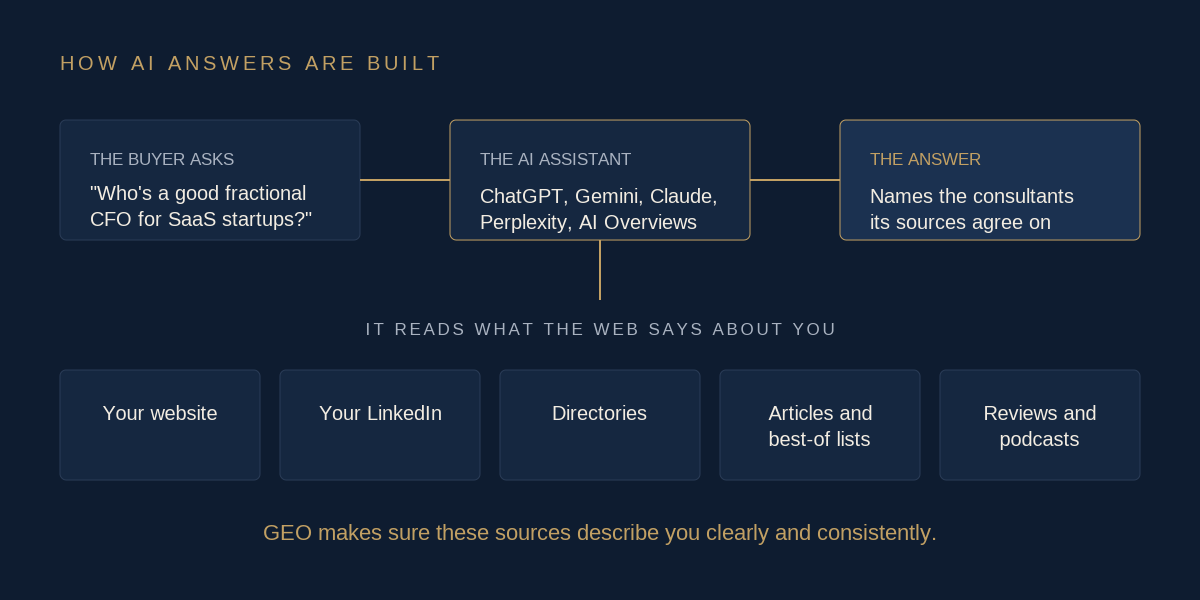
How AI tools decide who to mention
There is no public rulebook, and each tool works differently. But the patterns are consistent:
- They favour sources that clearly and directly answer the question
- They prefer information that appears consistently across several sources
- They lean on pages that are already well-ranked and well-linked
- They cite comparison articles, "best of" lists, directories and reviews heavily
- They describe businesses using the language those businesses, and others, use about them
What consultants should do
Be specific about who you serve. "Marketing consultant" is vague. "Fractional CMO for B2B SaaS companies in the UK" is something an AI tool can match to a question. Specialising helps here as much as it does on LinkedIn.
Make your site easy to understand. A clear About page, a dedicated page per service, structured data describing your business, and plain-language descriptions. Some sites also publish an llms.txt file, an emerging convention that gives AI tools a simple summary of the site.
Answer real questions. Articles and FAQs that directly answer buyer questions are exactly the kind of content AI tools quote.
Get mentioned where AI looks. Comparison articles, directories, podcasts, guest articles and industry roundups. If you are named in the sources AI cites, you are more likely to be named in its answers. Our guide to backlinks for consultants covers where to start.
Keep your details consistent. The same name, description, services and location across your site, LinkedIn, directories and profiles. Mixed messages make it harder for AI tools to describe you confidently.
Check what AI says about you. Ask ChatGPT, Gemini, Claude, Perplexity and Google the questions your buyers ask. Note who gets mentioned and which sources are cited. That is your roadmap. Our guide on how to get recommended by ChatGPT shows how.
The bottom line
AI assistants are becoming a front door for buyers looking for help. GEO is how you make sure you are inside when they open it. Be clear about who you serve, publish useful answers, and get mentioned by sources AI trusts.
Kräfte's SEO and GEO for consultants does exactly this, alongside traditional SEO, on a fixed monthly retainer.
Try it free: our AI visibility checker writes the buyer questions for you and opens them in ChatGPT, Gemini, Claude, Perplexity and Google.