TL;DR — Independent consultants win clients on LinkedIn by being clear, visible and personal. Rebuild your profile around the outcome you sell, post with a real point of view, engage with your buyers' posts before you pitch, target people showing buying signals, and treat DMs as conversations, not sequences. Do it consistently for a quarter and LinkedIn becomes your most reliable source of clients.
Why LinkedIn works so well for consultants
When you are an independent consultant, you are the product. Buyers are not comparing software features, they are deciding whether to trust you with a problem that matters to them. Before they book a call, almost all of them will look you up, and LinkedIn is where they look.
That makes LinkedIn two things at once: your shop window and your sales channel. Most consultants only use it as the first, a CV that sits there. The ones who win clients from it use it as the second.
The good news is that you do not need a huge following. You need the right few hundred people to recognise your name, understand what you do, and hear from you at the moment they need it.
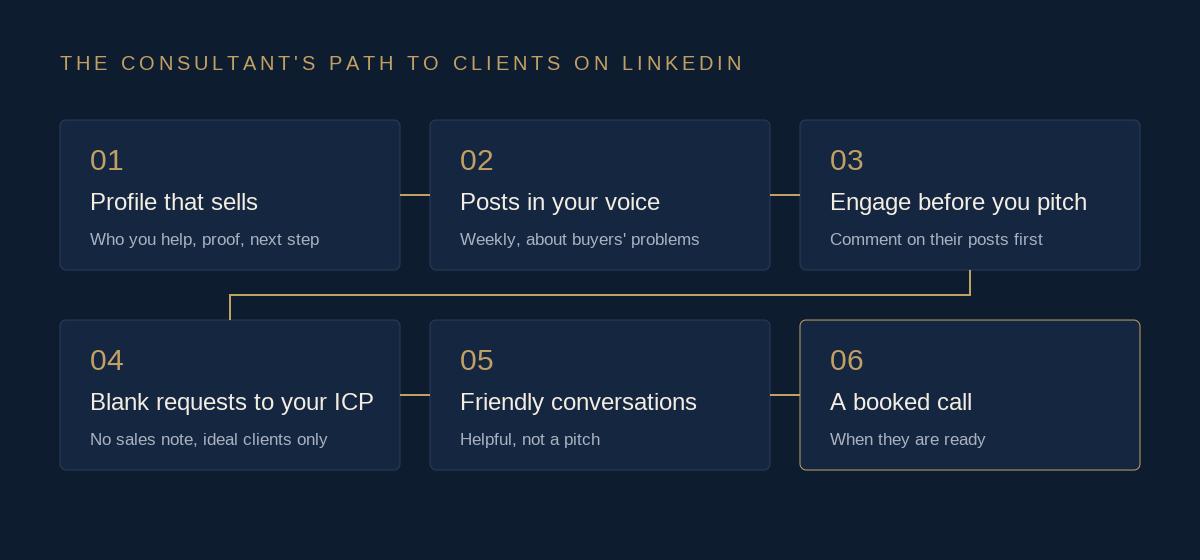
Step 1: Turn your profile into a sales page
Your profile is where every other activity lands. If a prospect sees a great comment from you, clicks through and finds a vague CV, the moment is gone.
Fix these first:
- Headline: who you help and the outcome you deliver. "Fractional CMO helping B2B SaaS founders fix pipeline" beats "Marketing Consultant | Strategist | Speaker".
- Banner: one line that repeats your promise, plus a simple proof point or call to action.
- About section: written to the buyer, not about you. Their problem, how you solve it, what working with you looks like, and how to get in touch.
- Featured section: a case study, a strong post or a simple "book a call" link.
- Photo: a clear, friendly, recent headshot. It matters more than it should.
We go deeper in our LinkedIn profile checklist for consultants.
Step 2: Post with a point of view
Content is what makes people recognise you before you message them. But the feed is crowded, and generic tips get scrolled past. What cuts through is specific and opinionated:
- Stories from client work (anonymised where needed) and what you learned
- Mistakes you see your buyers making again and again
- Frameworks you actually use, explained simply
- Clear opinions on the debates in your field
Two or three good posts a week is plenty. Consistency beats volume. Our guide to a LinkedIn content strategy for consultants covers what to post and how to keep it going.
Step 3: Engage before you pitch
This is the step most consultants skip, and it is the one that makes outreach work.
Before you message a prospect, spend a week or two showing up in their world. Like their posts. Leave a considered comment that adds something, a question, a counterpoint or an example. Not "Great post!", but something that shows you read it and know the topic.
By the time your connection request arrives, your name is already familiar. Acceptance rates go up, replies go up, and the conversation starts warm instead of cold.
Step 4: Target people showing buying signals
Most LinkedIn outreach goes to anyone with the right job title. That is why most of it fails. A better list starts with intent: people and companies with a reason to need you now.
Signals worth watching:
- New in role: leaders in their first 90 days often reset budgets and bring in new advisers.
- Hiring: a company hiring for a role you could replace, speed up or support.
- Funding and growth: fresh funding, new markets, new offices.
- Talking about the problem: people posting or commenting about exactly what you fix.
- Engaging with your space: prospects reacting to your posts, your peers' or your competitors'.
- Profile views: people who have already looked you up.
Ten conversations with people who have a live reason to listen are worth more than a hundred with people who do not.
Step 5: Treat DMs as conversations, not sequences
The fastest way to burn a warm connection is to pitch in the first message. Instead:
- Connect with context. Reference something real: their post, their new role, a shared interest. Keep it short.
- Start a conversation. Ask a genuine question about their world, or share something useful with no ask attached.
- Earn the right to suggest a call. When they mention the problem, offer a short call to look at it together.
- Follow up like a human. One or two thoughtful follow-ups, spaced out, each adding something new.
We share examples in LinkedIn outreach messages for consultants that don't sound like spam.
Step 6: Book the call, then keep the relationship
When the prospect is ready, make booking easy: a direct calendar link or two suggested times. And if they are not ready, stay in touch. Keep engaging with their content. Many consulting deals close months after the first conversation, with the person who stayed visible.
The real problem: time
None of this is complicated. The hard part is doing it every week, alongside client work. Profile upkeep, two or three posts, daily engagement, outreach and conversations add up to five to ten hours a week. And the first thing to go when a big project lands is prospecting, which is exactly how consultants end up in the feast-or-famine cycle.
That is why many consultants hand it off. At Kräfte we run LinkedIn management for consultants end to end: rebrand, content in your voice, engagement, intent-led connection requests, manual DMs, full conversation handling and booked meetings, on a fixed monthly retainer. You approve the content and take the calls.
We work with marketing consultants, financial consultants, IT consultants and AI consultants across the US, UK, Europe and the GCC.